Country of the Sea of Dragons
Tatsu-no-Umi-no-Kuni (龍海國, also read Ryūkai-koku) is a fantastical underwater kingdom nestled against the volcanic coastal shelf of Aishiji, the great archipelago-realm above. Aishiji is a land of daimyō and shogun, of pine-clad mountains and rice-terraced valleys, ruled until recently by a shogunate whose sudden dissolution has thrown every vassal in earth and sea into uncertainty. The Dragon-Sea-Country is one such vassal, and a most unusual one. For centuries it has paid tribute to the surface throne in pearls, coral, and ambergris; in return it has received charcoal, tin, iron, and the assurance that the surface would not try to fish its waters. With the Shogun's assassination, that arrangement is now in jeopardy, and the realm beneath the storm-belt is deciding what it wishes to be. Roughly two hundred and seventy thousand souls inhabit this realm, divided into six peoples whose fortunes and functions intertwine like the strands of a kelp-rope.
The Long Dark & The Waters Beneath
The kingdom sits beneath the Amagumo-no-Ikari (天雲の怒), a permanent storm-belt that smothers its skies for weeks or months at a time in what the realm calls the Long Dark (永闇 or Nagaki-Yami). When the storms break, the sun reaches the reef in pale shafts, and the realm celebrates with the Festival of Returning Light (光戻祭 Hikarimodorinomatsuri), releasing thousands of bioluminescent lanterns upward into the water column. But for most of the year the realm lives by the glow of lantern-jellies, phosphorescent coral strains, and whale-oil shrine-fires — a blue-green twilight world where colour is precious and darkness is the norm.
The reef itself is not merely natural. Centuries of sunken warships and merchant vessels, carried by the sea currents to these waters, have been colonized by coral and incorporated into the cityscape. The masts of long-dead ships serve as the pillars of temples; rusting cannons form the cornerstones of courtyards; lacquered hulls become the walls of guild-houses. The realm is built on the bones of the surface world, quite literally, and its architecture tells the history of Aishijian naval warfare in layers of accreted wreckage and living stone. However, many people now live in houses of unliving stone. As the population has swelled under the dragons' rule, the realm could no longer wait the years required for a Sango-mori to grow a coral house. To meet the demand, the Kanikō quarry two great stones: dark, heavy basalt hacked from the volcanic shelf, and pale reef-limestone cut from ancient, long-dead coral massifs. To bind them without air or fire-drying, the crab-smiths invented a marine mortar — a hydraulic cement mixed from volcanic ash gathered near the vents, crushed shell-lime baked in geothermal air-pockets, and the brine of the deep. Unlike surface mortars, this kai-mentsu (sea-cement) does not dry; it reacts with the saltwater itself, curing into a substance as hard as the reef-rock within a tide-cycle. The result is a brutalist, fortress-like architecture of black basalt and white limestone, imposing and instantaneous, lacking the organic elegance of grown coral but standing unyielding against the strongest currents.
The Four Counties
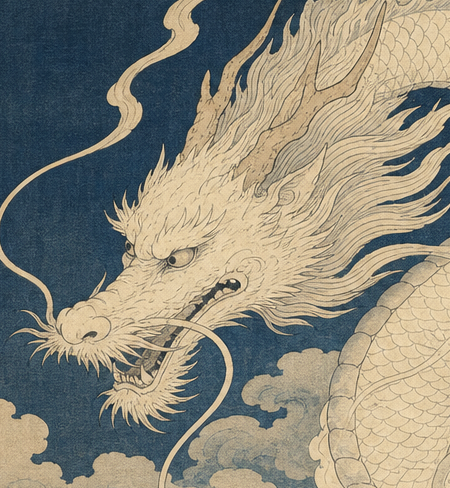
The realm is governed from the Pearl-Spiral Palace (真珠螺旋宮, or Shiratama-Uzumaki-no-Miya; or Shinju-Rasen-Guu; or Zhēnzhū Luóxuán Gōng) by the Ryūjin-no-Ōkimi (龍神の大君), the Great Lord of the Dragon-Gods, and by his court of some six hundred Ryūjin administrators. Beneath the Palace sprawl four counties, each overseen by a great and mighty Dragon-Lord from the high peerage of the realm.
- East County (東郡, Higashi-gun) faces the Aishijian shore, where the waters are shallowest and lit longest when storms permit. Here the wrecks fall thickest, and here the Shizumi-kumi salvage-guilds work their trade. East County is wealthy, cosmopolitan, and culturally hybrid.
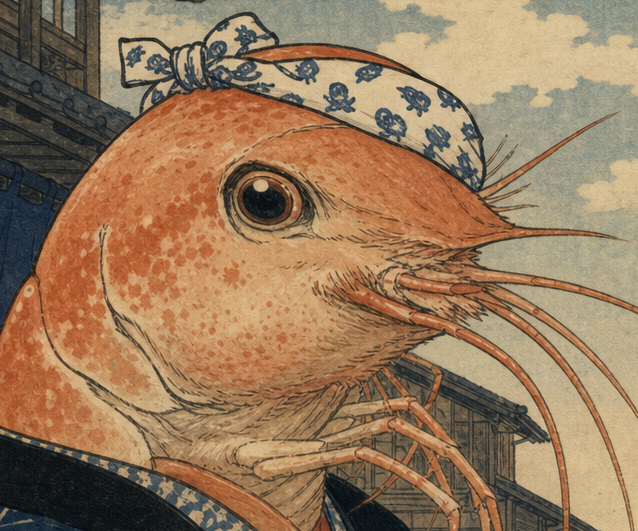
- South County (南郡, Minami-gun) is warm, broad, and fertile — the realm's breadbasket. Vast coral-farms, kelp-forests, and the great shrimp-folk paddy-reefs fill its waters. Most populous of the counties; predominantly ebikō and kanikō.
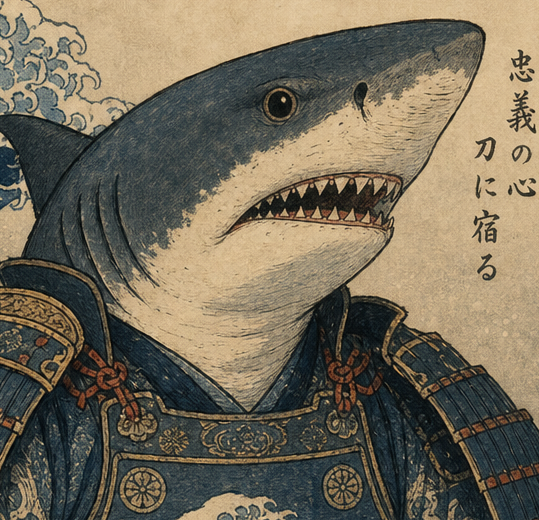
- North County (北郡, Kita-gun) is cold, deep, and sparsely populated but resource-rich — the realm's industrial frontier. Whale-falls, deepwater corals, rare bioluminescent species, and the great vent-forge complex of Kajiya-no-Ana, the Smith's Pit. The samebito clans are strongest here, and the open sea calls out to those sharks who would embark upon pilgrimages to their ancient tribal waters.
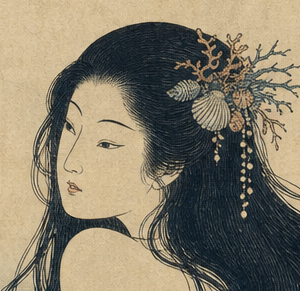
- West County (西郡, Nishi-gun) is the smallest and strangest county. Its waters face the open ocean, across which — far beyond the horizon — lies the ancestral Ryūjin homeland, whispered of only in the oldest scrolls. West County holds the 海神大社 Watatsumi Taisha, the great ancestral shrine, and its ningyo maintain ritual purity and archaic dialects. Pilgrims from across the realm come seeking visions. Something may be stirring, across that western sea. The Watatsumi Taisha is also an advanced school for water and nature magic, and any Onmyōji worth her or his salt has gotten her or his papers here.
Agriculture & Pastoralism
Because the Long Dark smothers photosynthesis for extended periods, the realm cannot rely on sun-fed agriculture as surface civilizations do. Instead, it maintains three overlapping food-systems:
Chemosynthetic foundation. The reef sits near hydrothermal vents and cold seeps along the trench edges, which support vast colonies of giant tube-worms, chemosynthetic clams, and bacterial mats cultivated on stone tablets. These are the staple proteins of the crab and shrimp classes — chewy, nutrient-dense, and utterly unglamorous. A kanikō family's vent-worm plot is inherited like rice-paddy land. Bacterial paste (yami-shō) serves as the realm's ubiquitous condiment, as fundamental to the undersea diet as miso is to the Aishijian.
Bioluminescent cultivation. Over centuries, ningyo coral-wardens have bred kelp and coral strains that fix energy through bioluminescent symbiosis — a magical-biological workaround for the absence of sunlight. Tsukikage-mo ("moonshadow kelp") grows in near-darkness by absorbing its own luminescence in cycles; its grain-like sporangia are milled into the realm's staple flour. Nagi-sui is a submerged rice-analogue, a grass-like kelp grown in flooded paddy-reefs. Light-coral produces edible mucus-pearls called tsuyu-dama — a luxury food and the basis of court cuisine.
Pastoral drover-economy. Beyond the storm-belt, sunlit outer waters support vast populations of fish, shrimp, and crab that the reef itself could never sustain. The realm's food security depends on bringing those calories home. Specialized drover-clans — mostly ebikō and samebito — spend months in the outer waters, gathering wild schools and managing semi-domesticated herds, before driving them home along current-lanes in great mobile shoals numbering in the millions. A major drive's arrival at the reef triggers round-the-clock processing. Since traditional drying or salting is impossible in the sea, the realm uses stranger methods: carcasses are sunk into anoxic, hyper-saline brine pools (shio-no-ike) on the seafloor to cure; meat is hauled into geothermally-heated air-pockets over vents to be smoked by crab-folk holding their breath over whale-oil fires; choice cuts are sealed into giant kelp-bladders with bacterial pastes to ferment into pungent, long-keeping pastes; or simply lowered into the near-freezing abyssal trenches of the North to freeze solid. The realm's calendar is shaped by these drives; the phrase oidashi ga kaeranu toshi — "the year the drive did not return" — is the idiom for catastrophe.
Metallurgy & Industry
The Ryūkai-koku is essentially a Bronze Age polity with Iron Age salvage supplements. Its volcanic geology provides abundant copper from hydrothermal vent-chimneys and seep-field nodules, and the crab-folk Kōra-kaji smiths have mastered the working of bronze in air-pocket forge-chambers built over volcanic fissures. Bronze of various tin-ratios serves the realm for weapons, armor, tools, coinage, mirrors, bells, and architecture. Copper, even more abundant, is the everyday metal of household life — cookware, tableware, nails, fittings, and the low-denomination aka-sen coin. The realm's visual aesthetic is dominated by the colours of these metals: the warm red of fresh copper, the green-gold patina of aged bronze.
Tin, however, is the bottleneck. Cassiterite deposits are rare in island-arc geology, and the realm's only significant native source is the Shiro-ana ("White Pits") tin mines of West County, worked by a specialized kanikō sub-caste of hereditary deep-miners. These mines are slowly exhausting. Supplementary tin comes from salvage and from Aishijian imports controlled by the late Shogunate. The Ōkimi hoards the tin stockpile — the Shirogura, "White Vault" — as a state secret, and tin smuggling is the gravest economic crime in the realm, punishable by live burial in one's own shaft. The Shogunate's implicit threat of tin embargo has been a lever of power from the surface over the sea.
Iron and steel the realm can produce only poorly or not at all. Vent-forge smelting yields brittle wrought iron and cast iron — useful for structural work and industrial applications, but useless for weapons. The realm cannot carburize iron into steel, cannot forge-weld reliably underwater, and cannot reproduce the differential hardening that gives an Aishijian katana its hamon temper-line. Consequently, salvaged surface steel is sacred. A single recovered katana is worth more than any native weapon — a superweapon in the hands of a samebito champion, a religious relic often enshrined, a diplomatic gift of the highest order. The specialized Naoshi-kaji restoration-smiths, who can return a rust-eaten three-century-old blade to battle-readiness, are among the most honored figures in the realm.
Coral weapons supplement the metallic armory. The ningyo Sango-mori caste grows tool-coral over years into knives, spears, and blades. The militarized chi-sango (blood-coral) edge secretes an anticoagulant mucus that makes even glancing wounds bleed profusely; the restricted doku-sango (poison-coral) produces genuine neurotoxins and is a state monopoly reserved for declared wars of annihilation, as it has been since the tribal days, in the Age before Dragons.
Culture & Society
It is said that the ningyo and samebito were the first inhabitants of these waters, and that the former lived in fear of the latter. Then the Ryūjin came from across the western sea, and taught both to live in harmony, and to build houses and palaces like the great kingdoms above and below. Then they persuaded the loyalty of the crab peoples and the shrimp peoples. And then a great ancestor of the late Shogun did commune with the Ōkimi himself, and, seeing that this ancestor was wise and gifted with Heaven's wisdom, agreed to become a tributary of the new Aishijian Shogunate. So the realm's founding myth tells of two conquests — the Ryūjin's conquest by wisdom, and the Shogun's conquest by treaty — and its people understand themselves as subjects of both.
The dark waters of the country are stranger than most, and for whatever reason they beckon the womb to birth more of the fairer sex than the sterner. The Ryūjin appear to be either immune or only slightly affected by this, followed by the samebito, and then the others who are decisively mostly female. As such, women outnumber men roughly five to one across the realm as a whole, which has visibly shaped every institution. Inheritance is matrilineal — property, titles, and clan names descend through the mother-line. Men who marry into a clan take their wife's name. The dominant domestic arrangement is Kumi-kon ("bundle-marriage"), in which one husband is bonded to a sisterhood of wives — usually literal sisters, cousins, or sworn-sisters — who form the true economic and domestic unit. Because men are scarce, women compete for husbands through elaborate poetry duels, martial displays, and gift-giving tournaments called Kyōsō-uta. Men are legally classified as tenbutsu ("heavenly goods") and usually cannot be conscripted, imprisoned without a tribunal of seven matriarchs, or lawfully struck. All races are compatible with males from most species, especially humans; fishermen have been kidnapped and forced to mate with crab-women, shrimp-women, and shark-women — a grim practice the Ōkimi's court officially discourages but has never fully eradicated.
Religion centres on the Cult of Watatsumi and the Ryūjin's divine ancestors, maintained by an overwhelmingly ningyo priesthood. Tide-shrines built into ship-hulls dot the reef; the Watatsumi-Taisha in West County is the realm's holiest site. Funerary practice commits the dead to the deep trenches, escorted by honor-guards, to prevent the desecration of ningyo flesh by those who would eat it seeking immortality. The dead carry a bronze coin in the mouth for the current-ferryman.
The realm's military doctrine reflects its material constraints and its caste-by-race structure. In any pitched battle, one can expect Samebito and their attendants to lead furious, impetuous charges straight into the spine of a hypothetical enemy army, because that is their right. They are a century behind in military thought, and military organization is a mix of tribal conditioning, bushido aped from the surface, and what scant few lessons of the art of war are unvaulted from the Forbidden Library of the Pearl-Spiral Palace. Ranged weapons are impossible underwater; ningyo war-mages serve as the realm's only "artillery," summoning whirlpools and pressure-bolts to break enemy formations at sea. They have not been tried on land. The military organization is archaic — samebito nobles fight with personal attendants rather than in modern regimental structures, and the entire army is a patchwork of clan-levies and caste-musters rather than a centralized standing force. It is a bronze-and-coral army in an age of surface steel.
Most of the military is female due to demographics. Interestingly enough, almost all ryujin that go to war are male, the samebito 30%, and the newly arrived shinnin have gender parity at the moment.
The one military unit that stands above the rest is the Blue Fang Palace Guard. They are Samebito champions who have undertaken esoteric training in order to hone their bloodlust and become as disciplined as the mythical Celestial Soldiers of Heaven. They ape an ancient and mythological organization and are rigorously trained and drilled such that they can be considered a disciplined regiment in this budding age of pike and shot.
The realm does not possess a navy of warships, or even trading ships, and not just for a lack of wood. The denizens of the realm are strong and all who aren't Ningyo can double as swimming pack mules in a pinch.
The realm cannot project much power towards the surface, but it is considered a powerful yokai kingdom. Lately, there has been talk in court about inviting and assimilating the kappa (turtle-folk) tribes somehow — a debate that reveals the realm's growing confidence, or perhaps its growing desperation for bodies in a dangerous world. In the past 20 years, strange people from the open ocean have come as refugees, speaking of calamity. These frog-fish-folk are now known as 深人 (shinnin), or "deep ones."